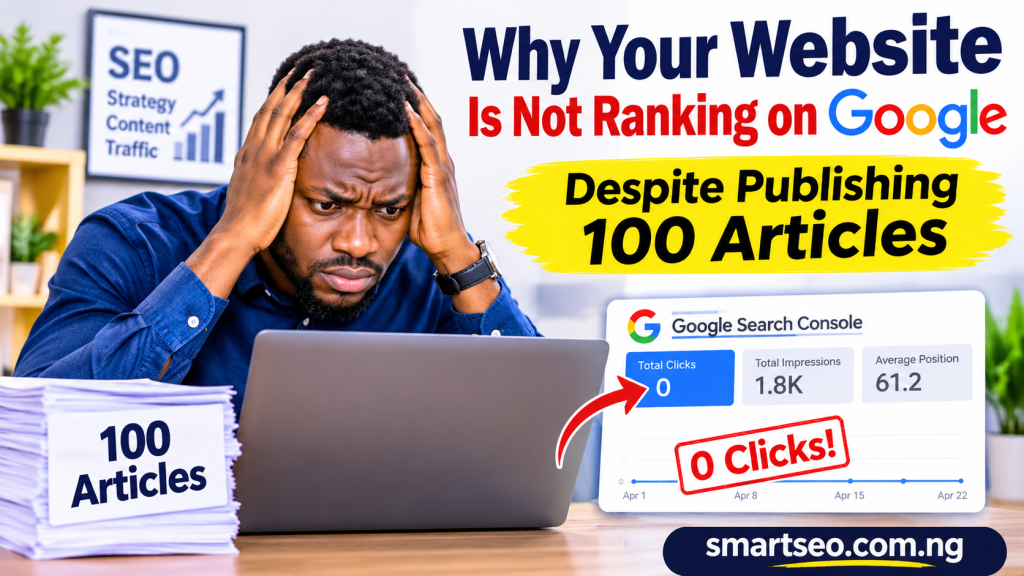
If your website refuse to rank even after publishing 100 well optimized article you need to read this and follow my instruction. The reason Why Your Website Is Not Ranking on Google Despite Publishing 100 Articles is either your doing something wrong or your niche has a very low search volume. That is why we carry out seo audit and niche research before we start any project at smartseo.
Let me ask you a question. What would you do if you spent six months publishing 100 articles on your website, followed keyword research recommendations, installed an SEO plugin, optimized your headings, and still received almost zero organic traffic from Google?
Many website owner will continue to publish more article hoping that one day it will suddenly spike. I know publishing more articles does not automatically make Google rank your website.
I have seen websites with hundreds of published articles struggling to attract visitors, while smaller websites with fewer pages receive consistent organic traffic.
The difference is not always the number of articles. It often comes down to how the website approaches SEO.
Whenever I investigate websites that struggle to rank, I do not immediately recommend publishing more content. I first want to understand what happens to the existing content, how the website targets keywords, whether Google can access its pages, and what makes those pages worth ranking.
In this article, I will explain why your website is still struggling after publishing 100 articles and what I would do differently if I were responsible for improving its rankings.
My goal is simple: help you stop wasting time producing articles that do not contribute to your website’s growth.
You can also check this topic: Google AI Overviews Can Change How People See Your Brand Here’s What Businesses Need to Know.
1. You Are Publishing Articles Without Building a Keyword Strategy
This is one of the first problems I look for when auditing a website.
Many website owners publish articles because they find keywords with reasonable search volume. They write about those keywords, publish the content, and move on to the next topic.
But there is a problem.

They never consider how those keywords relate to one another or how the articles support the website’s main business.
For example, imagine you own a website that offers SEO services.
You publish these articles:
- What is SEO?
- What is digital marketing?
- What is website traffic?
- What is Google?
- What is online marketing?
- What is content writing?
You now have six articles, but you have not necessarily established authority around a specific subject.
Instead, I would build a more focused keyword strategy.
For example:
Main topic: Website SEO services
Supporting articles:
- How to improve website rankings on Google.
- Why websites lose organic traffic.
- How to conduct an SEO audit.
- How to build quality backlinks.
- How to optimize website content.
- How technical SEO affects rankings.
- How to find profitable keywords for a business.
Now, these articles have a relationship.
They help readers understand different aspects of SEO, and they give you opportunities to connect related pages through internal links.
I call this building a content relationship rather than simply building an article collection.
When I plan content for a website, I want every article to have a purpose. I want to know which main topic it supports, what search intent it addresses, and where I can link readers next.
My advice: Before publishing another article, review your existing 100 posts. Group them into relevant topics and identify the subjects where your website has a genuine opportunity to become an authority.
2. You Are Targeting Keywords That Are Too Competitive
Another reason your website may not rank after publishing 100 articles is that you are competing for keywords that established websites already dominate.
Let me explain.
Imagine you have a new website about real estate in Nigeria.
You decide to publish an article targeting:
- Houses for sale in Lagos.
- Best estate agents in Lagos.
- Cheap houses in Nigeria.
- Real estate investment in Nigeria.
These are valuable keywords, but their main competitors are from established property websites, real estate companies, news platforms, and other publishers.
Your website may not yet have enough topical relevance, useful content, or external recognition to compete effectively.
For me, I would approach the situation differently.
Instead of immediately targeting the biggest keywords, I would look for specific searches that reveal what potential customers actually want.
For example:
- 3-bedroom houses for sale in Ikota Villa Estate.
- Cost of buying a house in Lekki County Homes.
- Is buying a completed house better than building in Lagos?
- What to check before buying property in Lekki.
These searches are more specific and can help you reach people with clearer intentions.
I am not saying you should avoid competitive keywords forever. I am saying you should build your way towards them.
Start by identifying realistic opportunities, publish genuinely useful content, connect related articles, and gradually expand your keyword targets.
The lesson: Do not measure your SEO strategy by how many popular keywords you publish. Measure it by how many relevant searches your website can realistically satisfy.
3. Your Articles Answer the Keyword but Ignore the Reader’s Real Problem
This is a mistake I see in many content strategies.
Lets say a website owner discovers a keyword and immediately starts writing an article around it.
The writer includes the keyword in the title, introduction, headings, and conclusion. The article may even reach 2,000 words. But after reading the entire page, the visitor still cannot solve the problem that brought them to the website.
That is a content quality problem.
For example, somebody searching for “why is my website not ranking on Google” probably wants to understand:
- Why Google is not showing their pages.
- Whether Google has indexed their articles.
- Whether their website has technical problems.
- Whether their keywords are too competitive.
- Whether their content is useful enough.
- What they should do to improve their rankings.
If your article only explains what SEO means, you have missed the real search intent. I always recommend approaching content from the reader’s situation.
Before writing an article, ask yourself:
- What problem is this person trying to solve?
- What information do they already know?
- What information are they missing?
- What practical steps can I provide?
- What would make my article more useful than a generic explanation?
You do not need to make every article extremely long.
Sometimes, a well-researched 1,200-word article can provide more value than a 4,000-word article filled with repeated explanations. I would rather publish content that answers the right questions than content that simply reaches a particular word count.
I would rather publish content that answers the right questions than content that simply reaches a particular word count.
4. Google May Not Have Indexed Your 100 Articles
This is one problem you should check before spending money on more content.
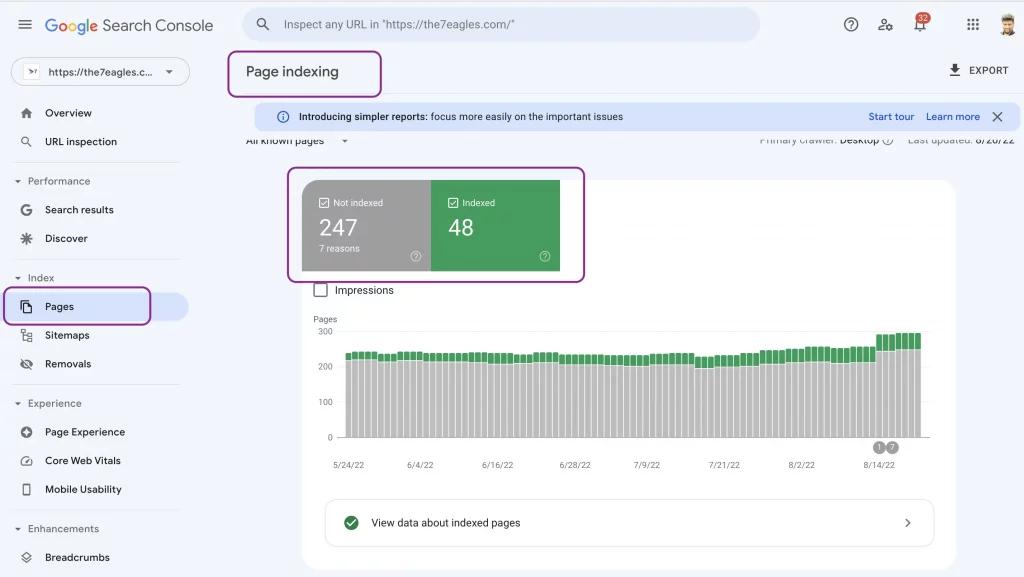
Publishing an article does not mean Google has automatically indexed it. Your article can exist on your website without appearing in Google’s search results.
I have come across website owners who spend money on writers, publish content consistently, and never check whether Google has discovered their pages.
That is a costly mistake.
I recommend opening Google Search Console and checking the Pages indexing report.
Pay attention to these issues:
- Discovered – currently not indexed: Google knows the URL but has not indexed it.
- Crawled – currently not indexed: Google has crawled the page but has not included it in its index.
- Excluded by noindex: A directive tells search engines not to index the page.
- Duplicate without user-selected canonical: Google has identified another URL as the preferred version.
- Page with redirect: The URL redirects somewhere else.
- Blocked by robots.txt: Your website may be preventing Google from crawling certain pages.
These statuses require different solutions. Do not assume every unindexed article has the same problem.
I would also check whether your XML sitemap works and whether important pages have appropriate internal links.
One more thing: submitting a sitemap does not guarantee indexing. It simply helps Google discover URLs. If you have published 100 articles, check how many are actually indexed before deciding that your content strategy has failed.
5. Your Website Has Too Many Articles Competing for the Same Keyword
This problem is commonly known as keyword cannibalization.
It happens when multiple pages target similar search queries and serve nearly identical purposes.
For example, imagine you publish:
- How to Rank Your Website on Google.
- Ways to Improve Google Rankings.
- How to Get Your Website on Google’s First Page.
- Tips for Ranking Higher on Google.
- How to Improve Your Website SEO.
These articles may target different keyword variations, but they could all satisfy almost the same search intent.
Instead of creating five pages that compete with one another, I would consider building one comprehensive resource and using supporting articles to cover genuinely different questions.
For example:
Main article: How to Improve Your Website Rankings on Google.
Supporting articles:
- How to Fix Website Indexing Problems.
- How to Build Internal Links.
- How to Improve Website Loading Speed.
- How to Find Low-Competition Keywords.
Then I would connect these pages naturally.
This gives each article a clearer purpose.
However, do not merge pages simply because they contain similar keywords. First, compare their search intent, Google Search Console performance, content quality, and existing backlinks.
If two pages satisfy different needs, they may deserve to remain separate.
6. You Are Publishing Content Without Building Internal Links
Imagine publishing 100 articles and leaving every article to stand alone.
A visitor reads one article, finds the information useful, and leaves your website because you have not shown them another relevant resource.
You have missed an opportunity.
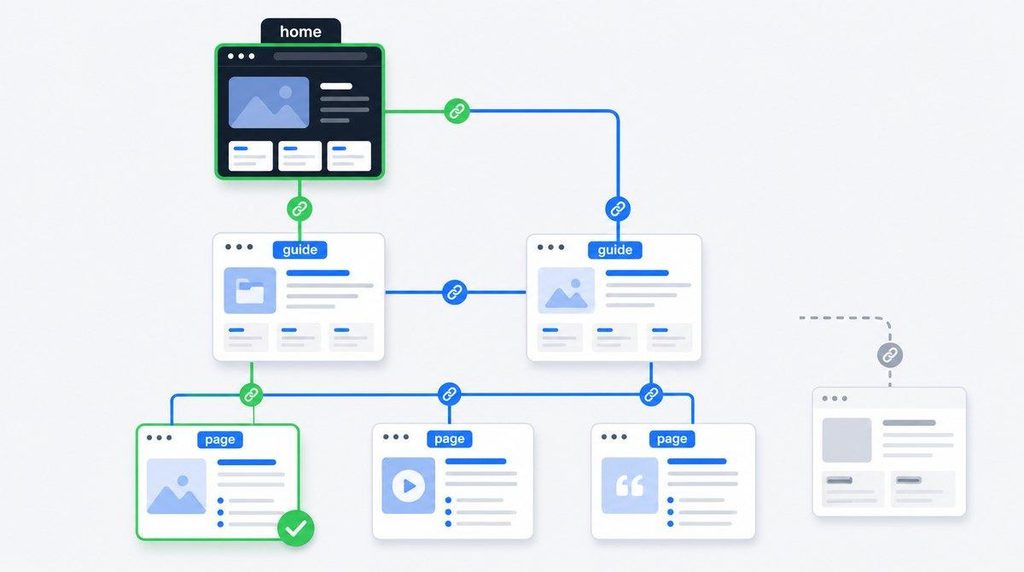
Internal linking helps visitors discover related information. It also helps search engines discover pages and understand relationships between different sections of your website.
For example, if I publish an article about technical SEO, I can link to other relevant articles discussing:
- Website indexing.
- Website speed optimization.
- SEO audits.
- XML sitemaps.
- Website architecture.
I would also link to relevant service pages when the context makes sense.
But I do not recommend adding internal links just to increase their number.
Every link should help the reader.
Here is another mistake to avoid: using the same exact-match anchor text repeatedly across every page. Write natural anchor texts that describe the destination.
For example:
Instead of repeatedly writing “SEO services” as your anchor text, use relevant variations such as:
- Professional website SEO optimization.
- Our technical SEO solutions.
- How we improve organic search visibility.
If you want to understand how we approach content creation, internal linking, and optimization, visit our SEO services page.
At SmartSEO, our content approach includes keyword research, updating existing articles, building internal links, and optimizing pages rather than simply increasing the number of published posts.
7. Your Website Has Weak Backlink Authority
Let me make something clear.
Publishing 100 articles does not automatically make other websites recognize your business as an authority.
You can publish excellent content, but if your website has very little recognition outside its own domain, competing for difficult search terms may remain challenging.
Backlinks are one way search engines discover how other websites reference your content.
However, I do not recommend chasing thousands of backlinks from random websites.
I have seen website owners spend money on cheap backlink packages because somebody promised them thousands of links within 24 hours.
That is not the approach I would take.
I prefer relevant links from genuine websites that have an established audience and publish content related to the subject.
Here are some backlink opportunities I would consider:
- Publishing useful guest articles on relevant websites.
- Getting mentioned by industry publishers.
- Creating resources other websites genuinely want to reference.
- Building relationships with businesses in related industries.
- Recovering unlinked brand mentions where appropriate.
- Earning links through original research and useful information.
Relevance matters.
For example, if you run a website about financial services, a relevant finance publication may provide a more meaningful backlink opportunity than an unrelated website with impressive-looking metrics.
Also, remember that Google does not treat every backlink equally. Paid links intended to manipulate rankings and excessive link exchanges can violate its spam policies.
I would rather build a smaller number of meaningful editorial relationships than purchase thousands of questionable links.
You can learn more about our approach to SEO and link-building services.
8. Your Website Is Technically Difficult for Google to Understand
Some website owners spend all their money on content while ignoring the platform hosting that content.
You may have excellent writers, useful articles, and well-researched keywords, but technical problems can prevent search engines from properly accessing or understanding your pages.
Here are some issues I would investigate during a technical SEO audit:
Website loading speed
A slow website can frustrate visitors, especially on mobile devices. Improve image sizes, remove unnecessary scripts, review your hosting performance, and optimize caching.
Mobile responsiveness
Your website should work properly on mobile phones. Check whether visitors can read your content without zooming, navigate your menu, and interact with important elements.
Broken links
Broken internal links make navigation difficult and can prevent visitors from reaching useful pages.
Poor website structure
Organize your website into clear categories. Avoid creating hundreds of disconnected URLs without a logical relationship.
Canonical problems
Check whether your pages use appropriate canonical URLs, particularly when similar content exists at multiple addresses.
Redirect problems
Avoid unnecessary redirect chains and ensure important pages redirect to the correct destinations.
Structured data
Use relevant structured data where appropriate. For example, valid article, product, and local business markup can help search engines understand certain information about your pages. However, structured data does not guarantee rich results or higher rankings.
I would not guess which technical issue affects your website. I would inspect the site, test important URLs, and use Search Console to identify problems.
That is why a proper technical SEO audit should come before another large content campaign.
9. You Never Update Your Old Articles
Here is something I want every blogger to understand.
Your SEO work does not end when you click the publish button.
An article you published six months ago may no longer provide the best answer to a search query. Prices change, businesses update their services, regulations change, and competitors publish better resources.
Yet many website owners keep producing new articles while ignoring the content they already have.
I would approach this differently.
Before writing a new article, I would check whether an existing page deserves improvement.
For example, suppose you published an article titled “Best SEO Tools for Small Businesses” last year.
I would review it and check:
- Are the tools still available?
- Have their prices changed?
- Are there better alternatives?
- Does the article contain outdated screenshots?
- Have competitors provided more useful information?
- Are there important questions the article does not answer?
- Does the page still satisfy the search intent?
I would then update the article with relevant information.
However, I would not change the publication date simply to make an old article look new. The update should provide real value.
I also recommend using Google Search Console to identify pages that receive impressions but very few clicks. Those pages may need better titles, descriptions, or content improvements.
Sometimes, improving 10 existing articles can create more opportunities than publishing another 30 articles without a strategy.
10. Your Website Has No Clear Topical Authority
This is one of the biggest problems I would investigate on a website with 100 articles.
Imagine visiting a website that publishes articles about:
- Dog food.
- Cryptocurrency.
- Real estate.
- Football.
- SEO.
- Travel.
- Insurance.
- Cooking.
There is nothing inherently wrong with a website covering multiple subjects. However, if it publishes unrelated content without a clear editorial structure, it may struggle to establish a recognizable subject focus.
I want Google and visitors to understand what my website does.
For example, if I operate a website about SEO, I want to develop meaningful coverage around:
- Keyword research.
- Technical SEO.
- Content optimization.
- Link building.
- Local SEO.
- Website audits.
- Organic traffic growth.
- AI search visibility.
I would connect these subjects and demonstrate practical knowledge.
This does not mean Google requires every website to cover only one topic. It means a focused content strategy can help you build a coherent resource for a particular audience.
The difference is important.
Do not publish 100 articles just because you have 100 keywords in your spreadsheet. Publish articles that support the audience and subject your website wants to serve. This are Why Your Website Is Not Ranking on Google Despite Publishing 100 Articles.
What I Would Do If My Website Had 100 Articles but No Google Traffic
Now, let us get practical.
Suppose I take responsibility for a website with 100 published articles and almost no organic traffic. I would not immediately recommend publishing another 100 articles.
I would start with an investigation. Here is the process I would follow.
Step 1: Audit All 100 Articles
I would create a spreadsheet containing:
- Article title.
- Page URL.
- Target keyword.
- Search intent.
- Indexing status.
- Google impressions.
- Organic clicks.
- Average position.
- Internal links.
- Backlinks.
- Recommended action.
This gives me a clearer picture of the website.
I can identify articles that need updating, pages that overlap, and content that does not contribute to the website’s main subject.
Step 2: Identify the Biggest Technical Problems
I would check:
- Google Search Console indexing reports.
- Robots.txt configuration.
- XML sitemap.
- Canonical tags.
- Broken links.
- Mobile usability.
- Core Web Vitals.
- Redirects.
- Website architecture.
I want to make sure Google can access the important pages.
Step 3: Identify Articles With Ranking Opportunities
I would not treat all 100 articles equally.
Some pages may already receive impressions but need better content.
Others may rank on page two or three and have an opportunity to improve.
I would prioritize articles with relevant search demand, realistic competition, and clear improvement opportunities.
Step 4: Rebuild the Internal Linking Structure
I would group related articles and connect them naturally.
I would also ensure important commercial pages receive relevant internal links.
The goal is to make navigation easier and help visitors discover other useful resources.
Step 5: Improve Content Quality
I would review the most important pages and improve them based on actual search intent.
I would remove unnecessary repetition, add missing information, include useful examples, and make the content easier to understand.
Where necessary, I would consolidate overlapping articles.
Step 6: Build Relevant Backlinks
After improving the website, I would identify opportunities to earn links from relevant publishers.
I would focus on quality, relevance, and genuine editorial value rather than purchasing random backlink packages.
Step 7: Monitor and Adjust
I would track the results weekly and compare performance over longer periods.
If impressions increase but clicks remain low, I would investigate titles and search intent.
If pages remain unindexed, I would investigate crawling and indexing issues.
If important keywords remain stagnant, I would review content quality, competition, technical SEO, and authority.
I would let the data guide the next action instead of publishing content simply to keep the website active.
Why I Believe Publishing Fewer, Better Articles Can Produce Better SEO Results
I want to make one thing clear.
I am not against publishing 100 or even 1,000 articles. A large website can attract substantial organic traffic when its content serves a clear purpose.
My concern is publishing content without a strategy.
If I manage a website, I want every article to contribute something.
I want it to:
- Answer a question people are searching for.
- Support an important subject on the website.
- Attract relevant visitors.
- Connect readers to other useful pages.
- Build trust in the business.
- Create opportunities for leads and sales.
This is the approach I take when developing content strategies.
I also believe website owners should stop treating SEO as a writing competition. You do not win because you publish more articles than your competitors.
You win opportunities when you understand your audience, provide better information, build website authority, and continuously improve your pages.
For a practical example, read how I ranked a competitive transport keyword from page 13 to position number one on Google.
That project demonstrates why I pay attention to keyword selection, content relevance, and a structured SEO approach.
Final Thoughts
If you have published 100 articles and your website still struggles to attract visitors, I would not advise you to give up on SEO.
But I would advise you to stop doing the same thing and expecting different results.
Your website may have an indexing problem. Your keyword strategy may be weak. Your articles may compete against one another. You may lack relevant backlinks, or your competitors may simply provide more useful information.
The solution starts with identifying the actual problem.
At SmartSEO, I believe every website deserves an SEO strategy that considers its current condition, competition, audience, and business objectives.
We do not believe in publishing articles just to increase a website’s content count. We focus on keyword research, technical SEO, content optimization, internal linking, and relevant link building.
If your website is struggling on Google, let us investigate what is holding it back.