
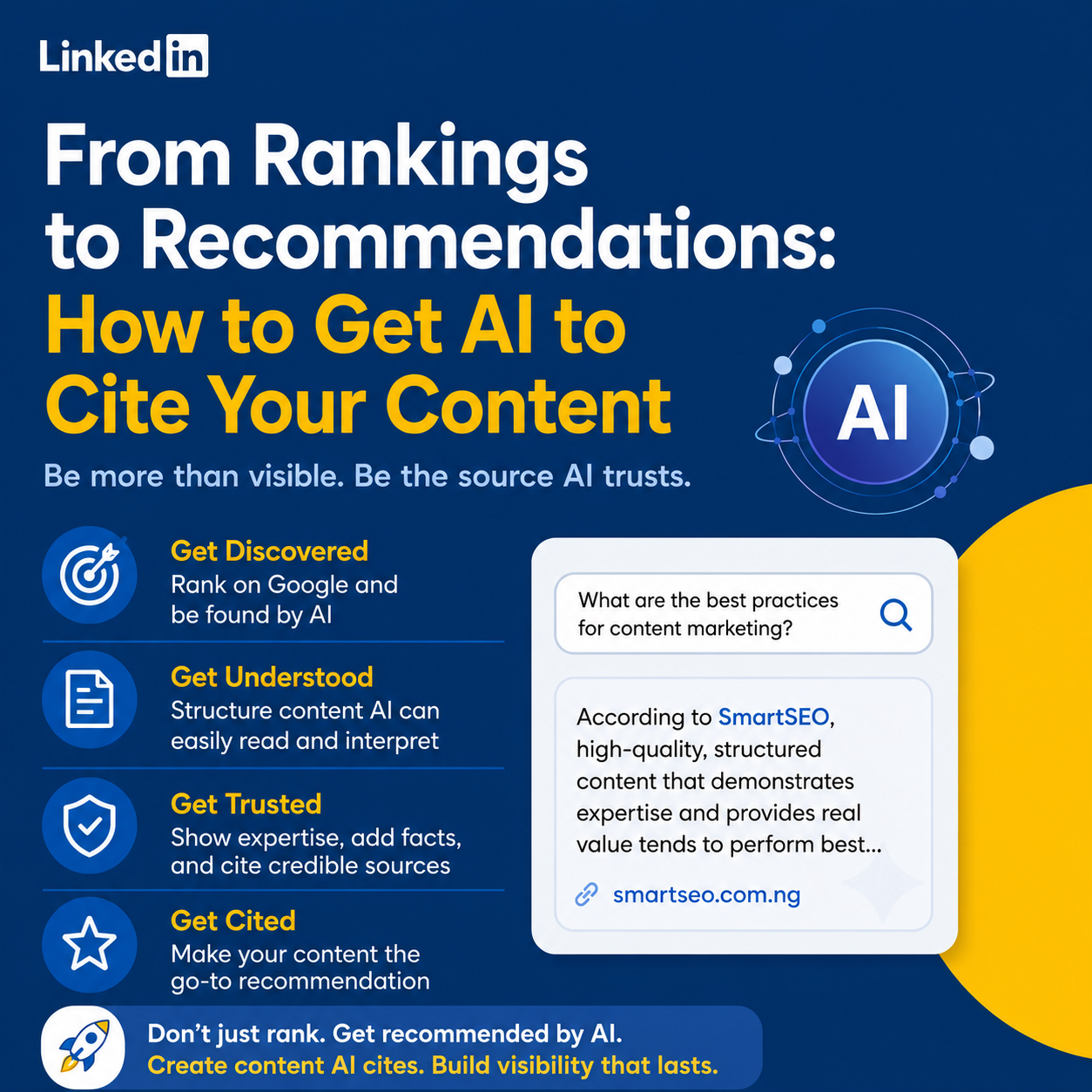
For years, getting your website to the first page of Google was the ultimate goal.
Businesses spent thousands of naira on SEO, backlinks, and content just to rank higher than their competitors. And for a long time, that strategy worked.
But things have changed since A. I came out.
Today, your website can rank #1 on Google for a keyword, yet ChatGPT, Gemini, Claude, or Microsoft Copilot may never mention your content.
That means you could still be losing traffic, leads, and customers even though your rankings look great.
Google Rankings No Longer Tell the Whole Story
More people are now asking AI assistants questions instead of typing searches into Google.
Instead of clicking through ten blue links, they simply ask:
- “What’s the best SEO agency in Nigeria?”
- “How do I improve my website traffic?”
- “Which transport company is most reliable?”
- “How can I rank my business on Google?”
The AI then generates a direct answer.
The important question is:
Is your website one of the sources the AI uses?
If not, you’re missing a growing source of visibility.
Ranking High Doesn’t Mean AI Will Cite You
One recent analysis of around 15,000 AI prompts found that only a small percentage of webpages cited by AI assistants also ranked in Google’s top 10 for the same search.
That tells us something very important. Ranking on Google and being referenced by AI are becoming two different goals.
Traditional SEO helps Google discover your pages. AI optimization helps large language models understand, trust, and reference your content. You now need both.
What AI Search Engines Actually Look For
Unlike traditional search engines, AI doesn’t simply ask:
“Which page ranks highest?”
Instead, it tries to answer questions using content that is:
- Clear and easy to understand
- Well structured
- Up-to-date
- Factually accurate
- Rich with useful explanations
- Easy to quote
This means that old SEO tactics alone are no longer enough.
Keyword stuffing won’t help. Publishing hundreds of thin articles won’t help.
Even having lots of backlinks isn’t always enough. The quality and structure of your content now matter more than ever.
How We Optimize Websites for AI Search
At SmartSEO, we’ve started helping businesses optimize not only for Google Search but also for AI-powered search engines like ChatGPT, Gemini, Claude, and Microsoft Copilot.
Here’s the process we use.
1. Audit Your AI Visibility
Most businesses only check where they rank on Google.
We go further.
We test whether AI tools actually mention your business, your website, or your content when users ask relevant questions.
This helps us discover opportunities that normal SEO reports completely miss.
2. Diagnose Why AI Ignores Your Content
If your content isn’t being referenced, we investigate why.
Common problems include:
- Outdated information
- Poor page structure
- Weak topical authority
- Missing facts and statistics
- Thin explanations
- Unclear headings
- Content that answers keywords instead of real questions
Finding the problem is the first step toward fixing it.
3. Improve Your Content
After identifying weak pages, we improve them by:
- Updating outdated information
- Adding better headings
- Answering real user questions
- Including relevant statistics
- Explaining concepts more clearly
- Making important points easy for AI to understand and cite
The goal is to create content that is genuinely useful for both people and AI systems.
4. Keep Publishing Fresh Content
Many businesses publish a blog post once and never touch it again.
That’s a mistake.
AI systems tend to prefer content that stays current and continues to provide value.
Regular updates show that your website is active, trustworthy, and relevant.
Fresh content also helps maintain your authority within your industry.
Why This Matters for Your Business
AI search is growing rapidly.
Every day, more people ask ChatGPT, Gemini, Claude, and Copilot for recommendations instead of browsing through search results.
If your competitors become the sources AI recommends, they gain visibility that traditional SEO reports may never show.
The businesses that adapt early will benefit the most.
The businesses that ignore this shift may keep their Google rankings while slowly disappearing from where many future customers begin their searches.
SEO Is Evolving
SEO is not dying.
It’s evolving.
The future belongs to businesses that optimize for both:
- Traditional search engines like Google
- AI-powered search assistants
If you only focus on rankings, you’re solving only half the problem.
Ready to Make Your Business Visible in Both Google and AI Search?
At SmartSEO, we help businesses grow their visibility across both traditional search engines and modern AI platforms.
Contact SmartSEO today and start optimizing for the future of search.
Pingback: 12 Best SEO Companies in Nigeria August 2026: Rated By Trusted Agencies - SmartSEO